

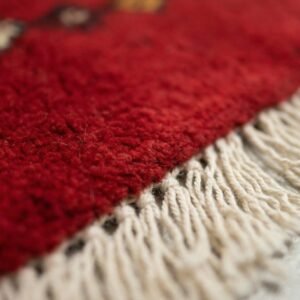
I was born in Bhadohi. I grew up watching weavers work. The question of how traditional Indian rugs are made is not abstract to me. It is the work of thousands of people I know by name, in towns and villages I have visited my entire life. Let me walk you through the process the way someone who has lived inside it would explain it.
Every traditional Indian hand-knotted rug begins with a design, called a naksha in the weaving communities of Uttar Pradesh. For traditional rugs, these designs are often inherited patterns passed down through families of weavers or adapted from historical Persian and Mughal sources. For custom and contemporary rugs, the design is created digitally and then translated into a graph paper chart called a taleem.
The taleem is the weaver’s instruction sheet. It maps every knot in the rug to a specific colour and position. In the most intricate rugs, a single square foot of pile might require 100 to 300 individual knots, each of which must be placed in exactly the right position to reproduce the design faithfully. A skilled taleem maker can read a complex design and translate it into a workable instruction chart in a matter of days.
In traditional Indian rug production, the fibre is selected and dyed before weaving begins. Wool is the primary material, washed, carded, and spun into yarn before dyeing. Natural dyes derived from plants and minerals have been used in India for centuries. Indigo from the indigofera plant produces blues and greens. Madder root produces the rich reds and terracottas associated with traditional Indian and Persian rugs. Pomegranate rind and onion skins produce warm yellows and golds.
The dyeing process requires skill and experience. The mordant, which is the mineral compound that binds the dye to the fibre, determines the final shade as much as the dye plant itself. A weaver family that has been dyeing with natural materials for generations carries knowledge in their hands that cannot be replicated by reading a manual.
“The process of making a traditional Indian rug is an act of patience. There is no shortcut in hand-knotting. Every knot must be tied, every row must be combed and cut, and the rug builds up slowly from the loom like a painting assembled one pixel at a time.”
Mohammad Taqib, Founder, Kaleen BabaThe loom is warped with vertical threads, called warp threads, in wool, cotton, or silk depending on the rug’s specification. These warp threads form the structural backbone of the rug. The weaver sits at the loom with the taleem in front of them and ties individual knots around pairs of warp threads, working row by row from the bottom of the rug to the top.
After each row of knots is completed, one or two weft threads are passed horizontally across the warp to lock the row in place. The pile is then combed down with a metal comb and cut to an even height with scissors. This process, tying, wefting, combing, and cutting, repeats for every row of the rug. On a medium-density rug, a single weaver completes approximately 10,000 knots per day. A 9×12 ft rug with 100 knots per square inch contains over one million individual knots.
When the weaving is complete, the rug is removed from the loom and taken through a series of finishing processes. It is first washed to remove the lanolin and any residual dyes, which also softens the pile and begins to reveal the true depth of the colours. In Bhadohi, many rugs are washed in the open air using river water, a practice that has continued for centuries.
After washing, the rug is stretched on a frame to ensure it dries flat and square. Once dry, the pile is hand-sheared to an even height, a process that requires a steady hand and considerable experience. Any uneven sections are levelled and the ends are finished with fringe work or overcasting depending on the rug’s style. A final inspection checks the pile height, colour accuracy, and structural integrity before the rug is packed for shipment.
Every rug we make at Kaleen Baba goes through this same process. The weavers who work with us in Bhadohi have been doing this their entire lives, as did their parents before them. When you buy one of our rugs, you are not just buying a floor covering. You are buying the accumulated skill of generations of craftspeople whose entire livelihood and identity is tied to the quality of their work. That is not marketing. That is simply what is true.
Every Kaleen Baba rug is made by hand in Bhadohi using the same traditional techniques described above.

 USD
USD