

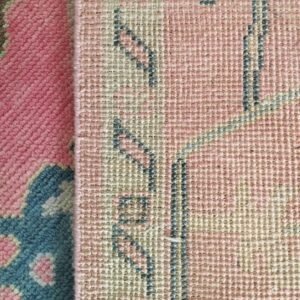
I have seen buyers pay premium prices for machine-made rugs sold as hand-knotted. I have seen importers label Turkish rugs as Indian and Indian rugs as Persian. The rug trade has always had room for misrepresentation, and buyers who do not know what to look for are the ones who pay for it. Here is what I check when I want to know whether a rug is genuinely what it claims to be.
The back of a rug tells you more than the front. A genuine hand-knotted rug shows the same pattern on the reverse as the front, with visible individual knots that have slight natural variation. You can see the warp threads running vertically and the weft threads crossing horizontally, with the pile knots tied around the warps.
A hand-tufted rug will have a canvas backing glued or stitched onto the reverse to hide the loops. This is not a defect, but it is important to know the difference. A machine-made rug has a completely uniform back, often with a latex or fabric layer pressed onto it. If the back looks too perfect, it is almost certainly machine-made.
On an authentic hand-knotted rug, the fringe is an extension of the warp threads that run through the entire length of the rug. It is structurally part of the rug, not a decorative addition. Pull gently on a fringe thread. It should be firmly connected, woven into the body of the rug.
On many machine-made and lower-quality hand-tufted rugs, the fringe is sewn or glued onto the end of the rug as a decorative element. If the fringe peels away easily or is clearly attached to a fabric tape at the edge rather than emerging from the pile itself, the rug is not hand-knotted.
“Every hand-knotted rug carries the signature of the weaver in its small imperfections. Perfectly uniform pile and flawlessly symmetrical patterns are signs of machine production, not craftsmanship.”
Mohammad Taqib, Founder, Kaleen BabaHand-knotted rugs made from natural wool have a quality called abrash. This is a natural variation in colour intensity across the rug, caused by small differences in the dye lots used during production. In traditional rugs, abrash appears as subtle horizontal bands of slightly different shading. It is not a flaw. It is evidence of handmade production.
Rugs dyed in large industrial batches with synthetic dyes have perfectly uniform colour from edge to edge. If a rug claiming to be hand-knotted has absolutely no colour variation, it warrants closer inspection.
Indian rugs vary significantly by region. Bhadohi and Mirzapur produce the bulk of India’s hand-knotted exports, using Persian knot techniques on wool foundation. Jaipur is associated with flatweave kilims and dhurries in bold geometric patterns. Panipat produces handloom and recycled fibre rugs. Kashmir produces silk rugs using the finest knot counts in the country.
A reputable manufacturer will tell you exactly where their rug was made and can provide a certificate of origin. If a seller cannot tell you which region the rug comes from or is evasive about it, that is a significant warning sign.
I grew up around rug production. I have been on the factory floor since I was a child watching weavers work. The knowledge I am sharing here is not academic. It is what every experienced buyer in this industry knows and what most sellers hope you do not. Use these tests every time you buy a handmade rug and you will not be misled.
Every Kaleen Baba rug comes with full documentation of origin, materials, and technique.

 USD
USD